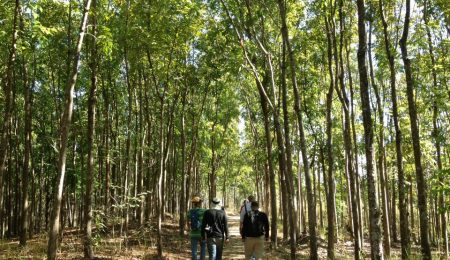

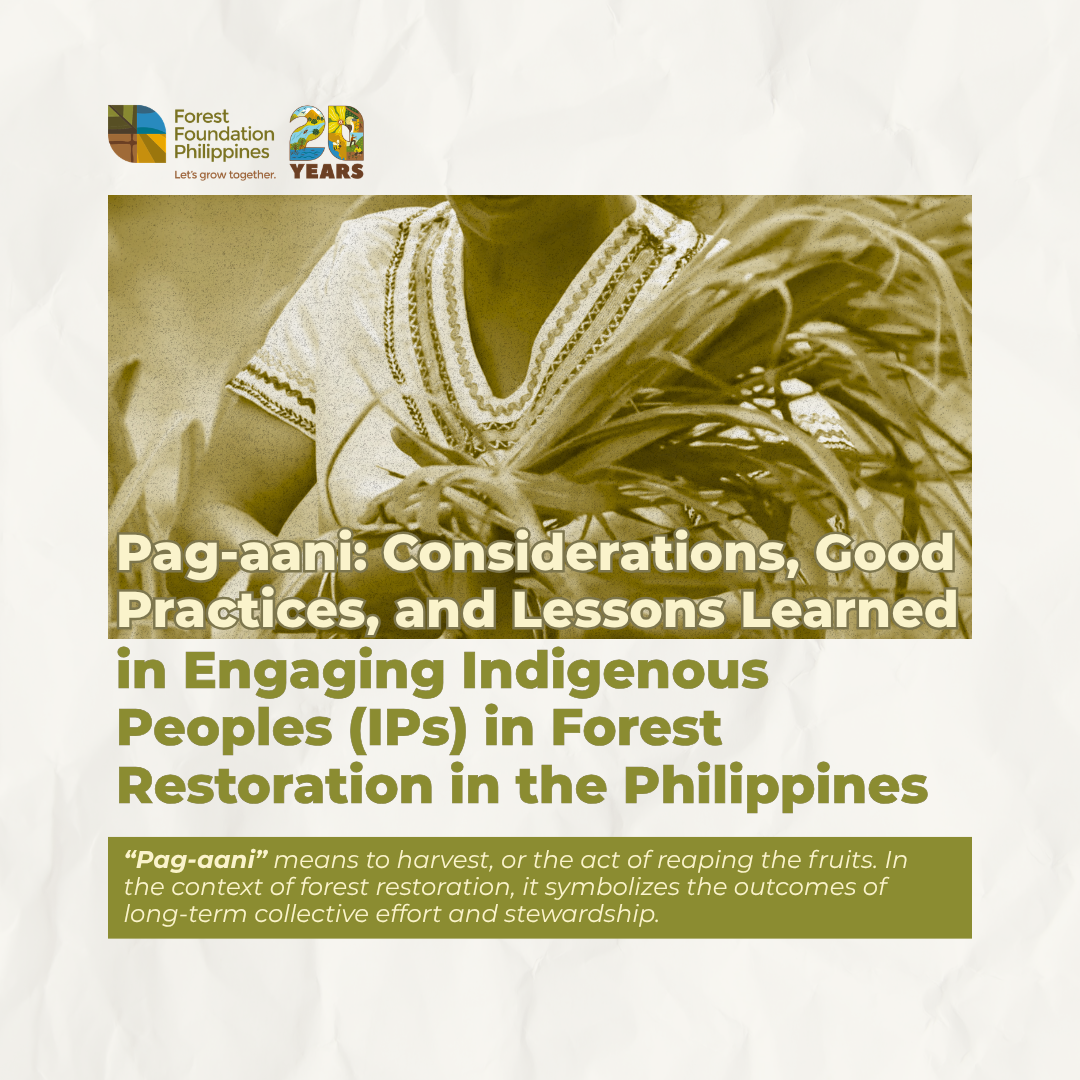
“Pag-aani” means to harvest, or the act of reaping the fruits. In the context of forest restoration, it symbolizes the outcomes of long-term collective effort and stewardship.
I. Background
The Philippines, the world’s second-largest archipelago with 7,641 islands, is one of the most biologically diverse countries globally. It is home to an estimated 14 to 17 million Indigenous Peoples (IPs), which is about 10 to 20% of the population. Many of them live in upland and forested areas where they practice long-standing stewardship grounded in Indigenous Knowledge Systems and Practices (IKSPs). Studies indicate that approximately 75% of the Philippines’ forest cover overlaps with IPs’ ancestral domains (traditional territories), underscoring their critical role in forest governance and restoration. For over 20 years, Forest Foundation Philippines has provided grants and technical assistance to organizations that empower communities to protect and conserve forests across the country. This includes over 700 projects supporting forest protection and restoration initiatives with IPLCs.
II. Considerations, Good Practices, and Lessons Learned in Engaging IPLCs in Forest Restoration in the Philippines
Based on Forest Foundation’s experience in providing grants and technical assistance to IPLCs across the Philippines, the following key lessons, good practices, and considerations have emerged:
A. Recognition and Respect of Indigenous Culture and Traditions
Projects are aligned with Indigenous Political Structures (IPS) and Ancestral Domain Sustainable Development and Protection Plans (ADSDPPs), and adhere to Free, Prior and Informed Consent (FPIC) processes. This ensures that forest restoration initiatives are grounded in customary governance systems, culturally appropriate land-use zoning, and IKSPs.
B. Transdisciplinarity of Forest Restoration
Forest Foundation integrates IKSPs with scientific approaches, recognizing forest restoration as an ecological, socio-economic, cultural, and institutional concern. Projects adopt a transdisciplinary approach that bridges local knowledge systems with science-based methods to ensure context-appropriate, effective, and sustainable restoration outcomes.
C. Empowerment of IPLCs as Co-implementers Communities are engaged as partners, rather than beneficiaries. Projects are co-developed and supported through capacity building in project management, financial management, and organizational development, with Civil Society Organizations (CSOs) providing mentorship and enabling partnerships. This approach strengthens local ownership, organizational capacity, and long-term sustainability of forest restoration initiatives.
D. Sustainability Mechanisms
Sustainability is supported through the integration of livelihood projects that support forest conservation outcomes, integration of initiatives into local development plans and budgets, and intergenerational leadership development that builds second-line leaders. These are complemented by the documentation and knowledge-sharing of good practices to support scaling-up, learning, and resource mobilization for long-term impact.
III. Conclusion
For many grantmakers, forest restoration is often measured through the scale of resources invested and the number of hectares restored. However, the experience of Forest Foundation Philippines highlights the importance of going beyond these metrics by deeply understanding forest landscapes and working in partnership with IPLCs in co-designing and implementing effective projects, rather than treating them as mere recipients of funding. Beyond biophysical outcomes, it is equally important to recognize the socio-cultural processes that enable meaningful and sustained restoration. Building strong partnerships and constituencies–grounded in trust, shared ownership, and local knowledge–is essential to achieving long-term forest restoration objectives which can be demonstrated through concrete and measurable results for ecosystems and well-being of IPLCs.
Reference:
ICCA Consortium. (n.d.). Territories of life: Philippines national report. ICCA Consortium. https://report.territoriesoflife.org/national-and-regional-analysis/philippines/.