
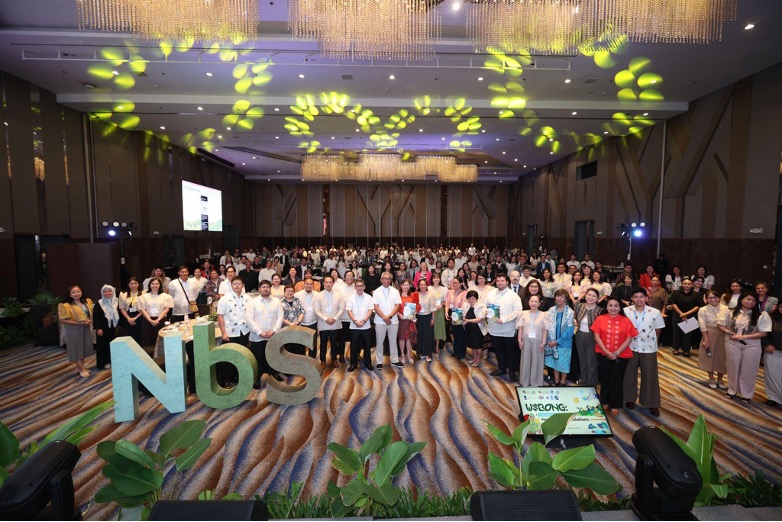
Manila, Philippines – The Department of Environment and Natural Resources (DENR), with the support from Forest Foundation Philippines, the Government of Canada (GAC), United Nations Development Programme (UNDP), and the NbS Support Network, launched the country’s first national-level Nature-based Solutions (NbS) policy at USBONG: Transdisciplinary Forum on Nature-based Solutions (NbS), held last June 30, mandating the integration of nature-based approaches into the country’s climate, biodiversity, and disaster risk reduction programs.
The Philippines is among the world’s most disaster-prone countries, with floods, droughts, typhoons, and earthquakes occurring regularly — a risk set to worsen under a changing climate, according to a joint climate risk profile by the Asian Development Bank (ADB) and the World Bank. Yet around 75% of regional GDP remains tied to nature, leaving economies exposed to disaster costs and lost productivity as ecosystems degrade, ADB’s 2025 Asia-Pacific Climate Report notes.
The NbS policy creates the institutional structure for collective action across government, communities, civil society, and the private sector within the DENR. “The NbS policy unifies our efforts to connect and strengthen action across sectors. It gives us a national standard for recognizing, supporting, and scaling nature-based approaches across our climate, biodiversity, and disaster risk reduction programs,” said Atty. Juan Miguel T. Cuna, CESO I, Secretary of DENR.
Yet locally-led approaches that uphold and enhance nature’s integrity are not new. The policy formalizes what Filipino communities have long carried forward. “For generations, Filipino communities and indigenous peoples have managed forests, restored coastlines, and stewarded the land long before it was called Nature-based Solutions,” shared Atty. Alaya de Leon, Deputy Executive Director of Forest Foundation Philippines.
The policy covers a wide range of ecosystems and project types, requiring DENR bureaus, regional offices, and local government partners to ensure that Nature-based Solutions are integrated into its plans and programs, backed by a national framework for monitoring, financing, and capacity building. It also calls for investment from local governments, the private sector, and communities, and mandates diversified funding sources, including payment for ecosystem services, for long-term sustainability. It is anchored in national laws such as the Climate Change Act of 2022 and the Indigenous Peoples’ Rights Act, aligning with the Paris Agreement and the National Adaptation Plan.
“The challenge before us is not simply adopting NbS. It is strengthening, connecting, and integrating the local and indigenous practices that already exist across policy, governance, financing, and implementation systems. That is the goal of USBONG,” said Dr. Dixon Gevaña, Director of Forestry Development Center, University of the Philippines Los Baños.
At the same event, the NbS Support Network was formally launched as its founding members — with the support of development partners, including the Government of Canada and Embassy of the Kingdom of Netherlands — signed a Memorandum of Understanding with the DENR. The Network will offer guidance for action at the national, regional, provincial, and local levels in designing, demonstrating, and implementing NbS, provide platforms for convening stakeholders, contribute to knowledge sharing on NbS, and demonstrate high-integrity NbS on the ground.
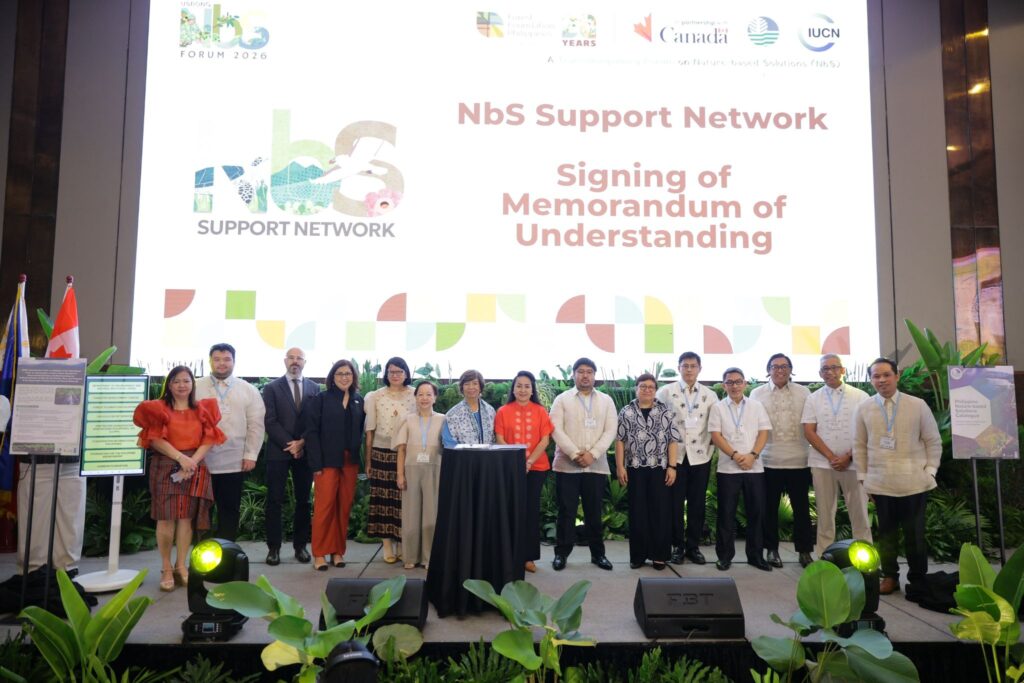
Founding members of the Nature-based Solutions (NbS) Support Network gathered on stage for the Signing of Memorandum of Understanding (MOU) during the formal launch of the Support Network at USBONG: Transdisciplinary Forum on Nature-based Solutions (NbS) held on June 30, 2026, at Novotel Manila Araneta City, Quezon City. [L-R] Undersecretary Atty. Analiza Rebuelta-Teh, Undersecretary for Finance, Information Systems, and Climate Change, DENR; Kelvin Gutmanis, Embassy of the Netherlands in Manila; Vlad Ionescu, First Secretary, Development Section, Embassy of Canada in the Philippines; Mae Chatto, Campaign Specialist of Oceana; Floradema Eleazar, Team Leader of the United Nations Development Programme (UNDP) Climate Action Programme Team; Amy M. Lecciones, Vice President and Executive Director, Society for the Conservation of Philippine Wetlands, Inc.; Dr. Annadel Cabanban, Country Director, Wetlands International – Philippines; Dr. Christie Monina M. Nalupta, Assistant Secretary General, Philippine Red Cross; Johnny Wyne Edaño, Ecological Modeling Specialist, Center for Conservation Innovations; Arlie B. Endonila, Chief Operating Officer, Haribon Foundation; Dennis Rosales, Program Lead, Foundation for the Philippine Environment; Jonas Tetangco, Country Representative of Catholic Relief Services in the Philippines; Wilson John Barbon, Country Executive Director, Conservation International – Philippines, ; Dennis Salvador, Trustee and Chairperson of the Programs Committee, Forest Foundation Philippines; and, Dr. Dixon Gevaña, Director of Forestry Development Center, University of the Philippines Los Baños.
Through the Philippines-Canada Partnership on Nature-based Solutions (NbS) for Climate Adaptation (PCP4NbS), Forest Foundation Philippines provides grants to community-based organizations to demonstrate NbS for climate resilience. The Program also drives conversations on the biodiversity-climate-gender nexus.
USBONG: Transdisciplinary Forum on NbS, served as the platform where this policy met the practitioners and communities it was built to serve. Building on PUNLA: NbS Forum 2025, USBONG deepened NbS across sectors, centering local practitioners and rooting gender-responsive, socially-inclusive NbS in the Philippine context.
The forum tackled seven themes spanning the full scope of NbS in the Philippine context — from inclusive governance, gender-responsive NbS, and climate action on Day 1, to food security, tourism, and climate resilient infrastructure on Day 2, to NbS financing on Day 3. Sessions featured panel discussions, dash talks, and fireside chats with practitioners, communities, government agencies, civil society, and the private sector, including a workshop on the IUCN NbS Self-Assessment Tool and a culminating workshop on the localization of NbS criteria and indicators led by the NbS Support Network, translating three days of discussion into concrete commitments for action on the ground.
Complementing the policy, the DENR, with support from UNDP and Government of Canada, also launched the NbS Catalogue, a practical reference designed to support the planning, design, and financing of NbS projects in the Philippines. Featuring standardized, evidence-based profiles of 21 priority interventions, the Catalogue will help local communities, government agencies, and other stakeholders identify and develop bankable NbS projects, thereby facilitating access to climate finance.
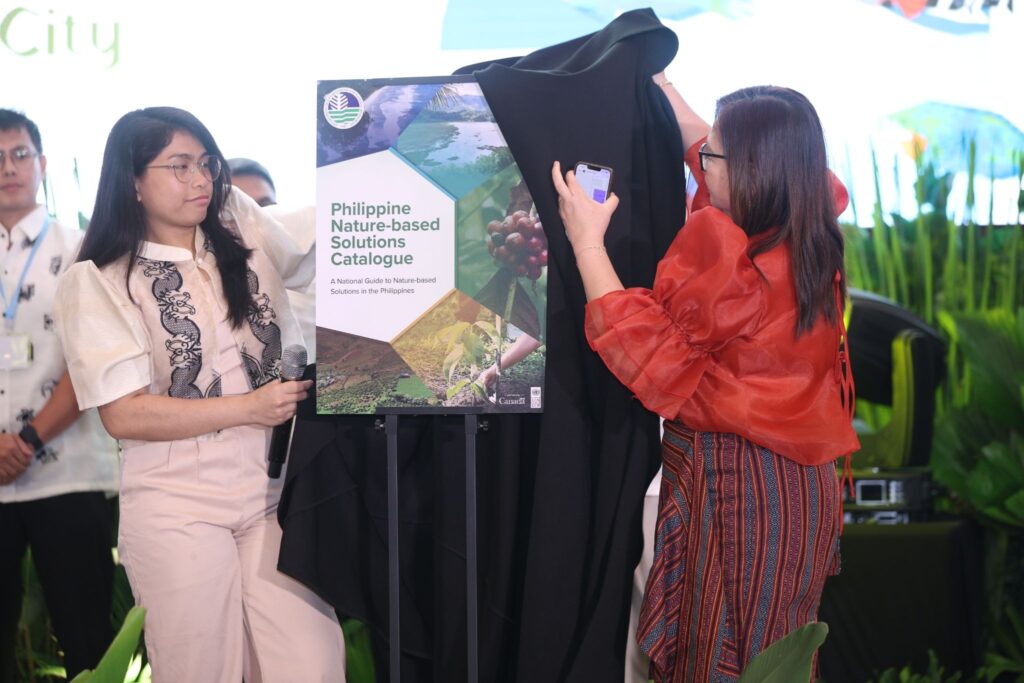
Undersecretary Analiza Rebuelta-Teh of DENR unveiled the NbS Catalogue during USBONG: A Transdisciplinary Forum on NbS on June 30, 2026 — a practical reference to support the planning, design, and financing of NbS projects in the Philippines.
“Nature is our greatest ally in addressing the climate and biodiversity crises while advancing resilient and sustainable development. Nature-based Solutions provide a powerful pathway to protect ecosystems, strengthen resilience, and improve people’s well-being. The NbS Policy and Catalogue lay the foundation for scaling these solutions across the Philippines, turning ambition into action for the benefit of both people and nature,” said Floradema Eleazar, Team Leader of the UNDP Climate Action Programme Team.
The NbS Technical Working Group will lead the mainstreaming of NbS standards across DENR’s policies and programs nationwide. Development partners Global Affairs Canada and UNDP continue to advance NbS financing and technical support on the ground, while commitments made at USBONG mark the start of turning collaboration into lasting action.
USBONG: Transdisciplinary Forum on Nature-based Solutions is organized by Forest Foundation Philippines, funded by the Government of Canada, and in collaboration with the DENR and the International Union for Conservation of Nature (IUCN). The forum is co-presented by the Embassy of the Netherlands in the Philippines and Philippine Red Cross. In partnership with UNDP Philippines, WWF-Philippines, and UPLB Forestry Development Center. With the support of IIRR-Asia, Conservation International Philippines, Wetlands International Philippines, Energy Development Corporation, IUCN National Committee Philippines, University of Guelph, and DOST PCAARRD.
About Forest Foundation Philippines:
Forest Foundation Philippines (doing business as Philippine Tropical Forest Conservation Foundation, Inc.) is a non-stock, non-profit, non-governmental organization that serves as a conservation financing platform to facilitate the flow of conservation funds from international and other donors to communities in the Philippines.
Established in 2002, the Foundation has been managing the Tropical Forest Conservation Fund, created through a debt-for-nature swap between the Governments of the Philippines and the United States. The Foundation works with government agencies and development partners in implementing grant programs such as the Mount Mantalingahan Protected Landscape (MMPL) Endowment Fund, the Philippines-Canada Partnership on Nature-based Solutions for Climate Adaptation (PCP4NbS), the Eighth Operational Phase of the Global Environment Facility (GEF) Small Grants Programme (SGP8), and the Integrated Approach in Management of Major Biodiversity Corridors in the Philippines (Biodiversity Corridor Project).
To strengthen collaboration in ecosystem restoration efforts, the Foundation also leverages financial resources and in-kind contributions through public-private-community partnerships.